

Seaweed Permaculture
the problem is the solution...

Algal blooms, whether on the beach at Cancun or the Lincoln Memorial Reflecting Pool, are not new. Drawing down CO₂ and burying organic carbon in sediments is part of Gaia’s regulatory system.
14,000 years ago, during the Antarctic Cold Reversal, there were massive blooms of the haptophyte Phaeocystis in the Southern Ocean. The resulting biological pump exported large amounts of organic carbon to depth, contributing to a measurable slowdown in the rise of atmospheric CO₂ during a critical transition phase between glacial Earth and interglacial Earth, preventing a Hothouse Earth acid reflux. Had that not occurred, runaway greenhouse warming could have ended our species.
During the Jurassic and Cretaceous, several Oceanic Anoxic Events (183 million years ago, 120.5 million years ago, and 94 million years ago) were marked by widespread low-oxygen conditions and extraordinary organic carbon burial. These anoxic conditions favored, rather than hindered, marine animals. The phytoplankton and other microalgae were food. We can see this in the thick black shales rich in organic carbon laid down at that time.
During that 92 million-year-old warming event, which was triggered by volcanoes, enhanced burial by algae blooms removed roughly 26% of atmospheric CO₂. If the blooms off Cancun and Palermo removed that much today, the atmosphere could be quickly brought back to 318 ppm CO₂, about where we were in 1965. That’s in the safe operating space before global warming kicked in.
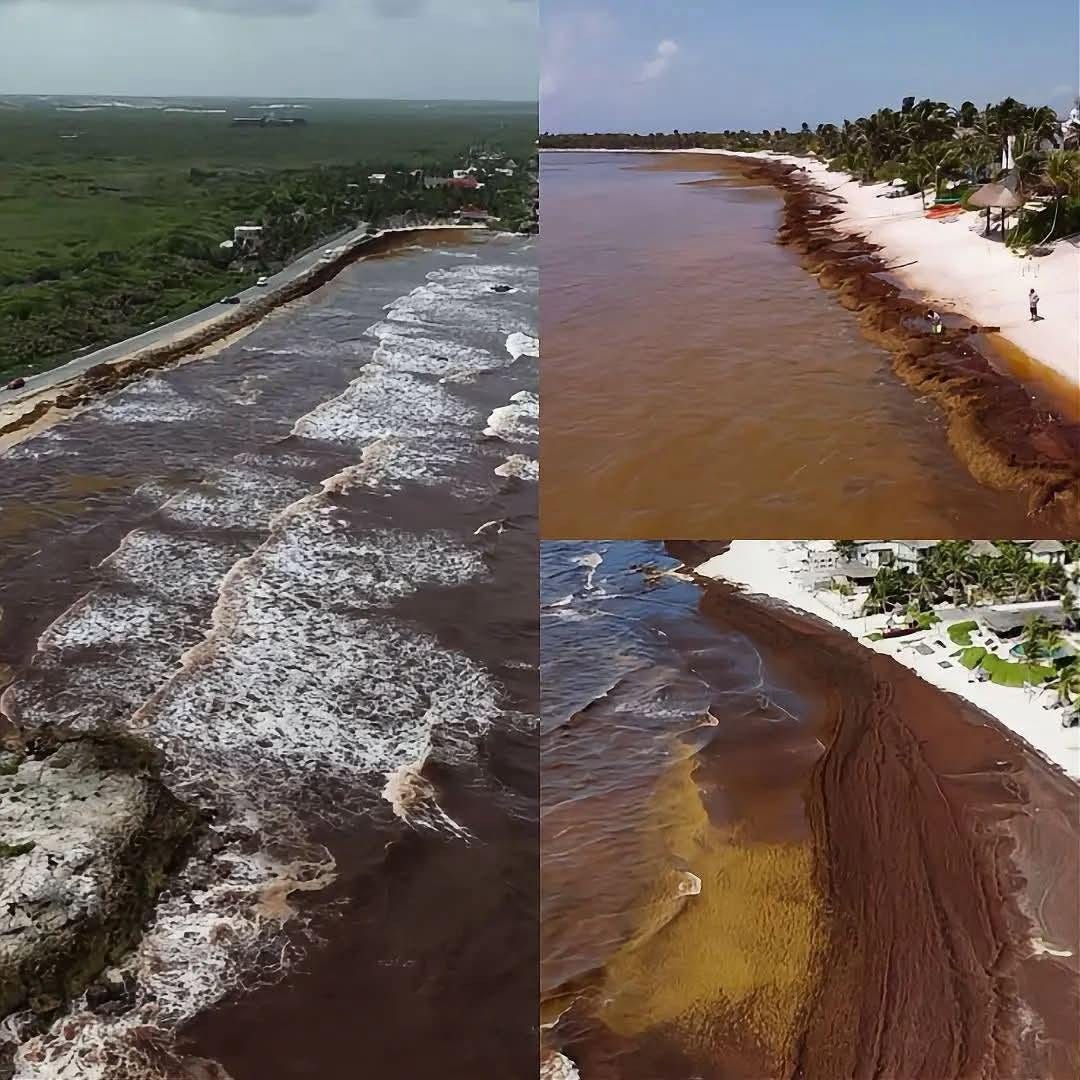
Four drivers converge to trigger algae growth today. Massive amounts of synthetic fertilizers, agricultural waste, and untreated sewage pour out of the Amazon, Mississippi, and Orinoco rivers. Iron-rich Saharan dust storms combined with coastal upwelling near West Africa inject critical micronutrients directly into the path of the drifting belt. Aging seaweed mats and the marine life living within them recycle phosphorus and nitrogen internally, allowing the bloom to grow independently of fertilizer in the open ocean. Warmer ocean surface layers—global heating—trap nutrients at the top of the water column, compounding optimal growth environments and allowing the seaweed to double its biomass in less than two weeks under peak summer conditions.
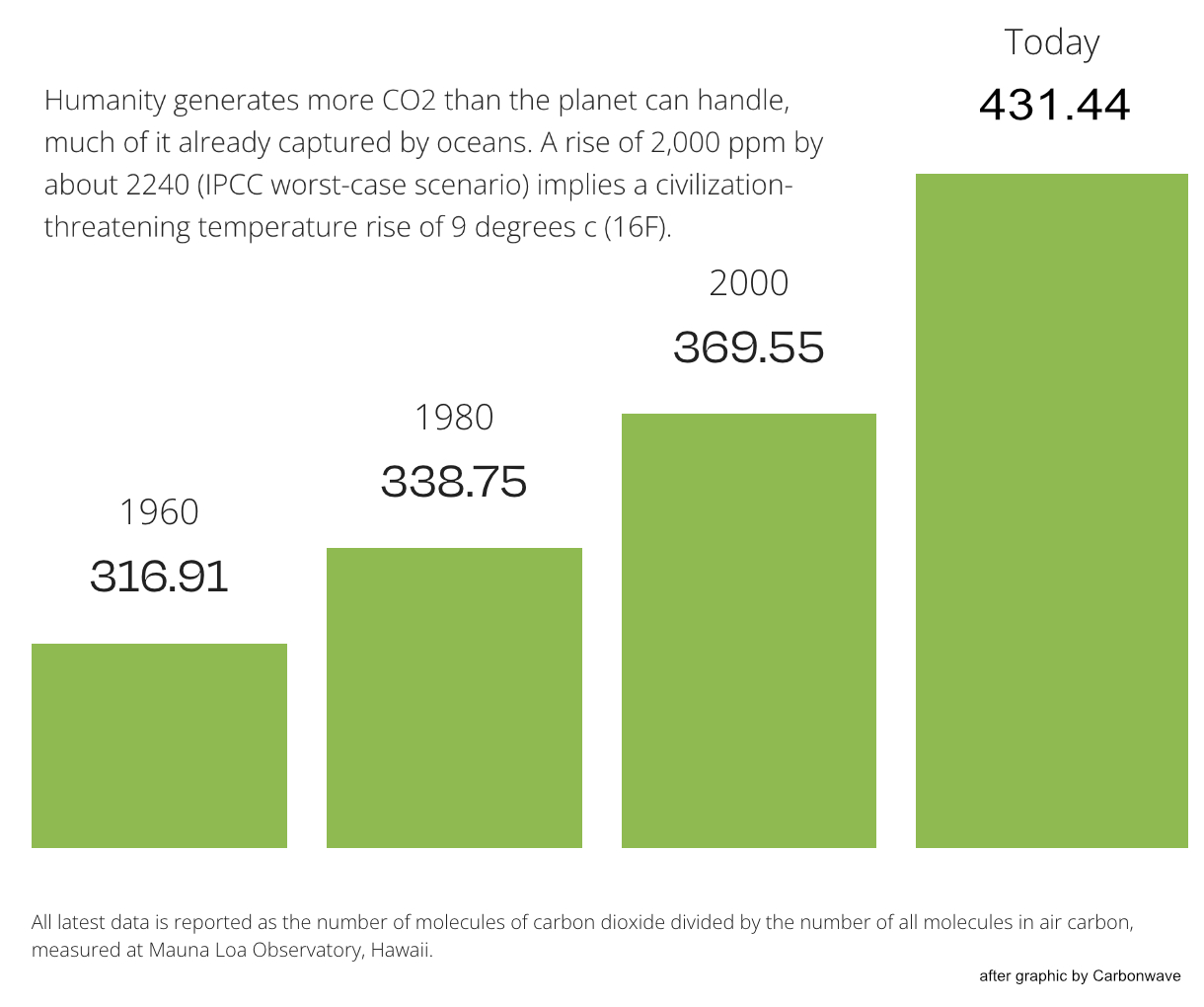
Over the past ~60 million years, marine algae have adjusted their carbon-concentrating mechanisms in response to CO₂, stabilizing us into the comfortable Holocene, a climate favorable to mammals like ourselves. Those paleo algal drawdown events, acting as planetary-scale “carbon valves,” worked their magic over thousands of years, however. Is there any way we could speed up the process and still have swimming beaches and an algae-free reflecting pool?
There is.
Burn
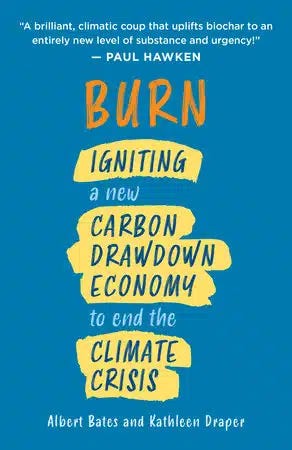
Some years ago, when Kathleen Draper and I wrote Burn! Igniting a New Carbon Drawdown Economy to end the Climate Crisis, we looked at all the promising markets for biochar that were either in progress or on offer and calculated that biochar alone, among all the natural climate solutions, could profitably withdraw 50 billion tons of CO2 annually, no taxpayer support required. Coupled with cuts to fossil fuel extraction and use (which biochar also assisted), this could restore Earth’s climate back from the scary Anthropocene to the familiar Holocene in decades, or perhaps a century or two.
If the blooms off Cancun were trapped and pyrolyzed, the atmosphere could be reverted to where it was in 1965, before global warming kicked in.
There was just one hitch. A bottleneck in the system would likely be encountered before midcentury when all the usual sources for woody biomass carbon to be mineralized into biochar and taken out of the CO2 cycle—crop residues, municipal and forestry waste, sewage—would be completely absorbed and we would still be well short of our 50 GtCO2/year ambition. New photosynthetic sources will be required if we’re to keep on target. On land, that is a problem. The annual net photosynthetic capacity of land-based biomass—scientifically measured as terrestrial Net Primary Production (NPP)—is around 60 billion tons C. Land-based ecosystems produce roughly 110 to 130 billion metric tons of dry organic biomass annually, and only about a third of that, if all of it were used, could be pyrolytically mineralized into biochar. I’d rather keep the old growth forests, thank you very much. And we need 10 trillion more trees, too.
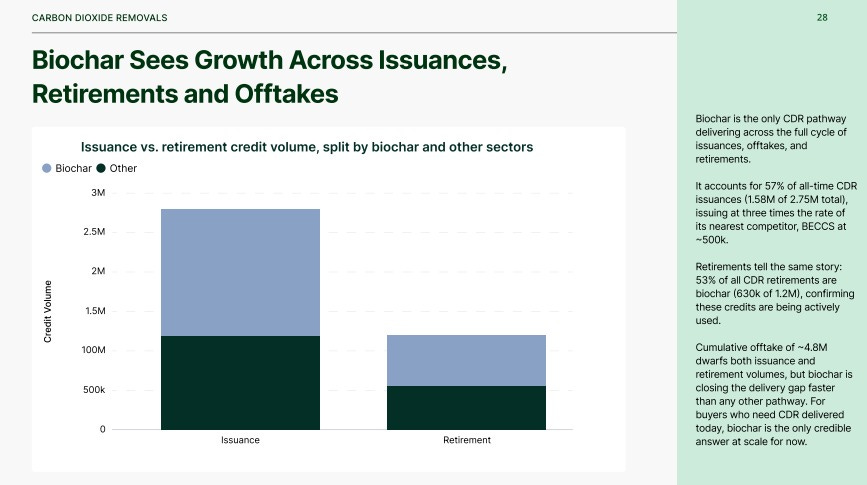
We proposed going beyond the land limit by using marine permaculture (kelp farms and marine forests, which also bring back the carbon drawdown from whales).
It is estimated that marine phytoplankton collectively fix about 50 gigatons of CO₂ every year—roughly half of all carbon fixation on the planet (Prasad).What makes microalgae particularly exciting in climate action is their efficiency in carbon assimilation. Unlike land plants, which are limited by factors such as soil quality and water availability, microalgae can grow rapidly in controlled environments, sequestering carbon at rates up to 50 times higher than terrestrial plants. —Arif Gasilov
By 2011, the algae growth in the Caribbean was already impacting tourism. Hotels were losing millions. Coral reefs were suffocating, marine animals were dying, and harmful methane and heavy metals were being spewed onto the beaches along with seaweed-collected plastic debris.
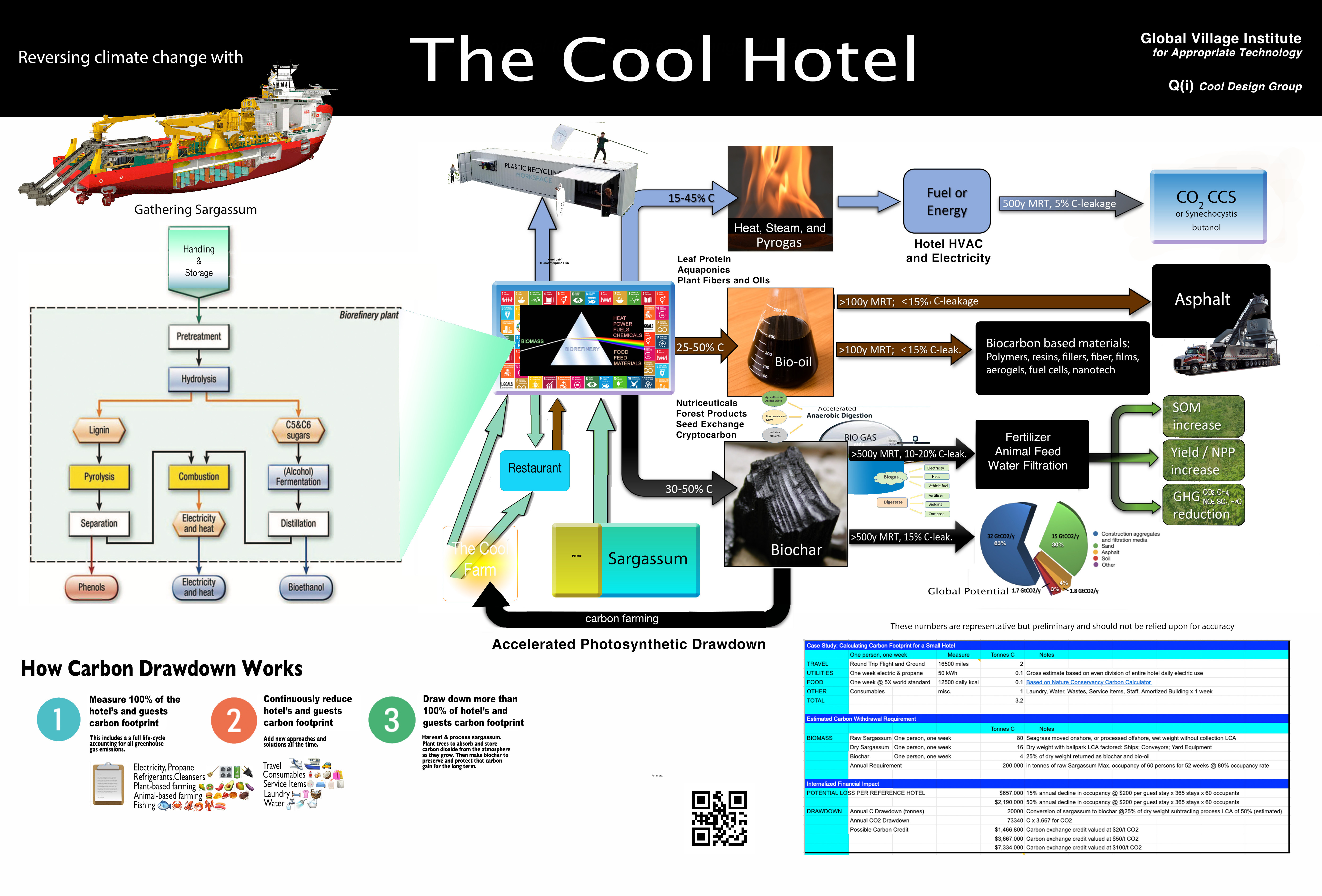
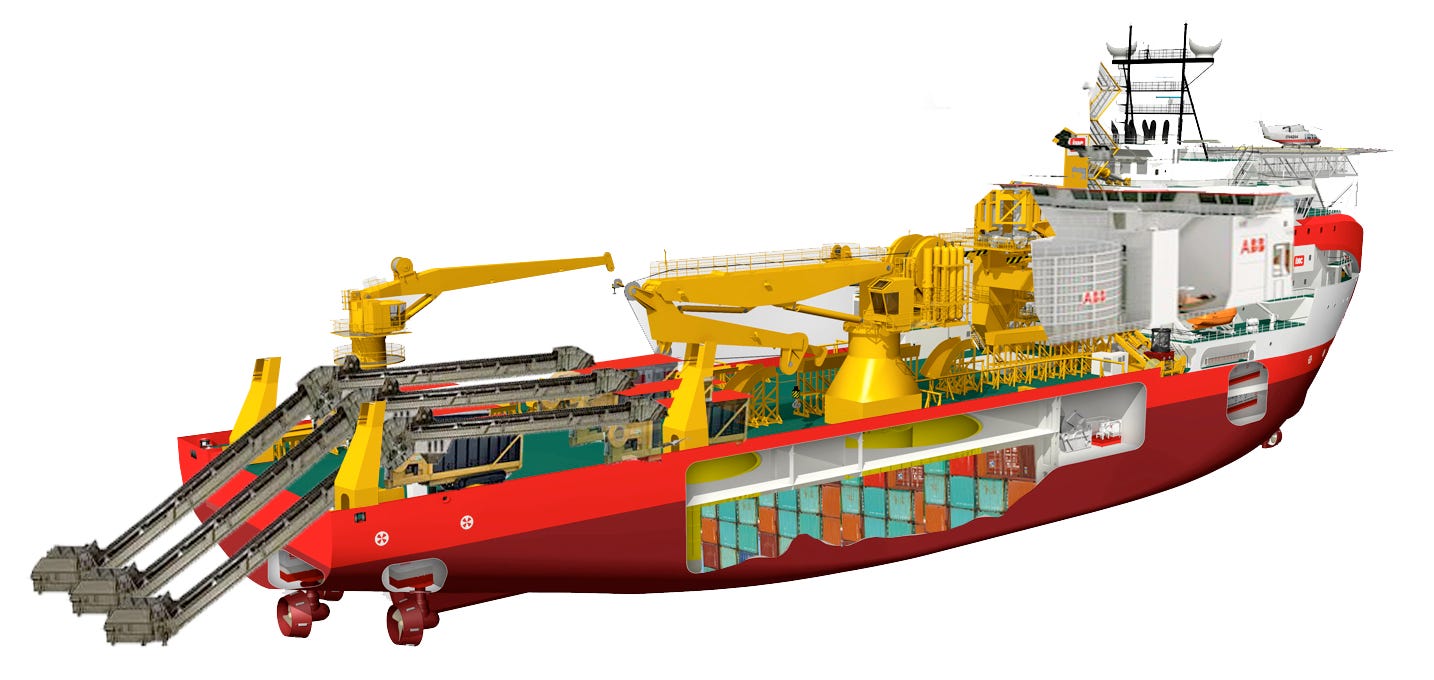
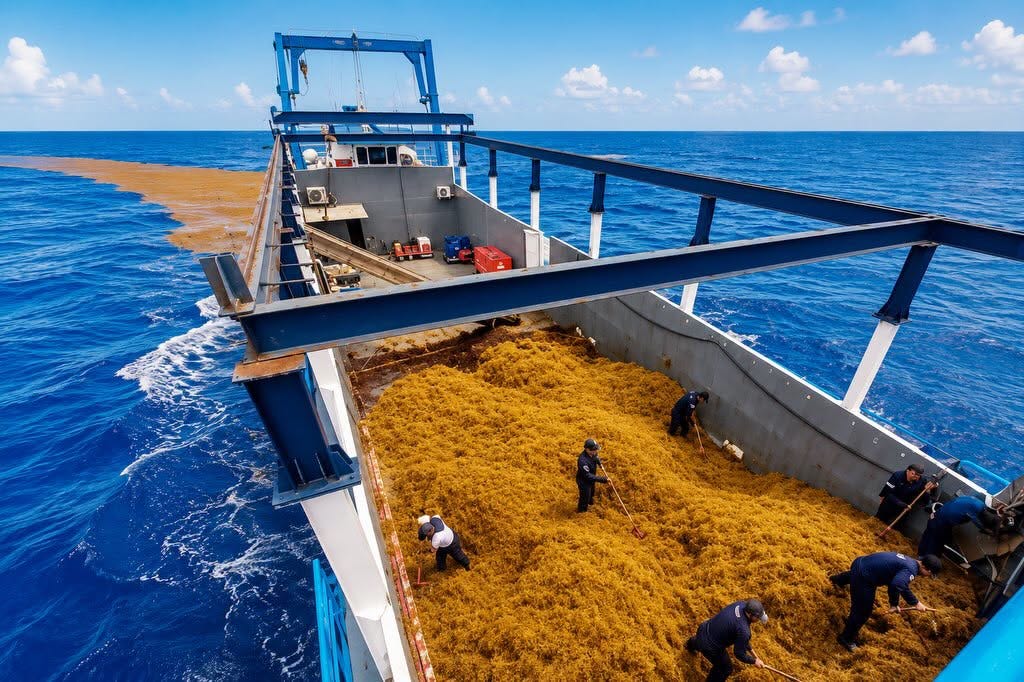
In 2017, I presented the above Cool Hotel idea at a poster session of the North American Biochar Conference. My concept was to gather sargassum from the beaches (actually offshore) and render it into biochar at sea on specially designed vessels. It now seems Claudia Sheinbaum, the climate scientist turned president of Mexico, or perhaps the carbon geeks on the UNAM study project she commissioned, took that idea and ran with it. My concept vessel looked like this:
Hers (she has commissioned and built six as part of the 2.6 billion-peso plan) looks like this:
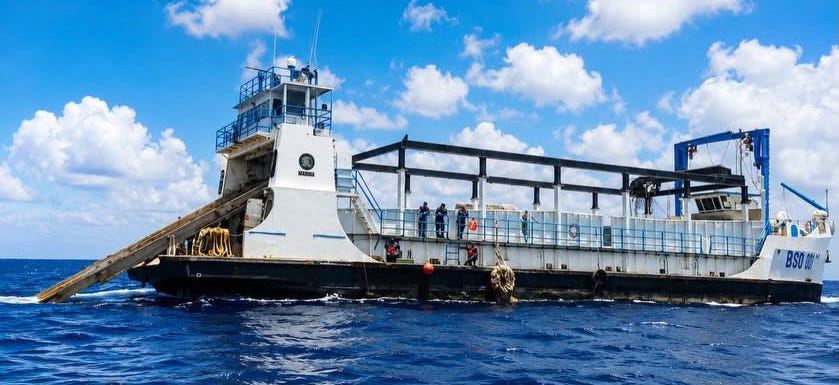
These ships have a capacity of 600 tons daily. They collect sargassum trapped by floating coastal barriers. That prevents it from reaching the beach and decomposing.
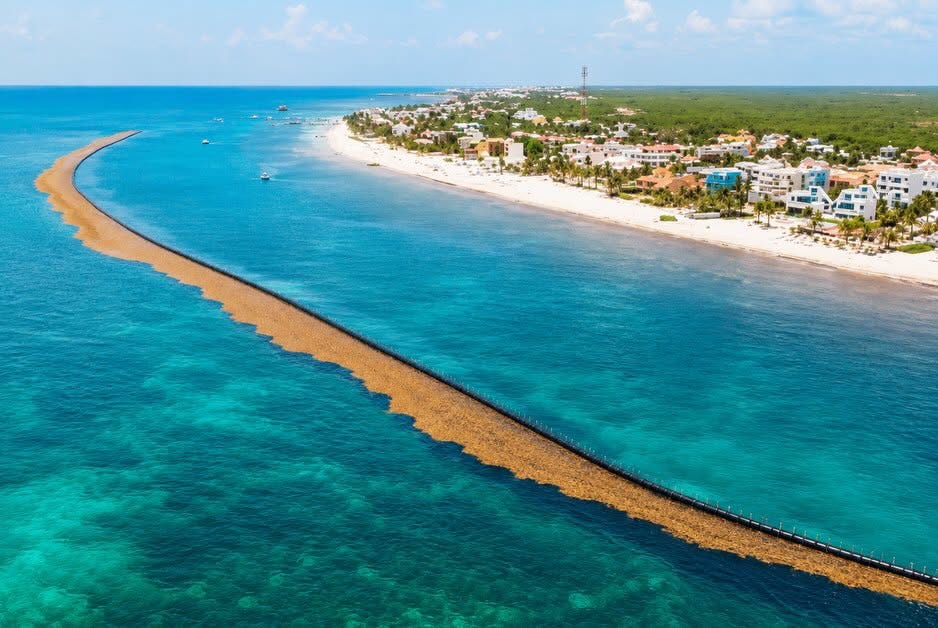
The Mexican plan calls for tripling capacity to 4000 tons per day by 2027. But what happens then?
That is where the carbon cascades begin.
The dominant approaches for Sargassum appear to be successive processing through a biorefinery approach which takes advantage of the water in the seaweed. The Sargassum Biorefinery (SaBre) coordinated by Rutgers University consists of three stages. The first stage conditions the sargassum and removes toxins, especially arsenic. The second stage, “enzymatic deconstruction and biofoundry-driven synthetic biology”, converts the components to sugars and ferments the sugars. The third stage, Thermochemical conversion and integration, uses hydrothermal liquefaction to convert residues to liquids and biochar. Additional thermal processes are being explored. SaBre is one of several biorefinery approaches which are at the research or early development stage.
—Tom Miles, Biochar Google Group
Carbon Cascades
Three years after my poster session—a work of fiction—Carbonwave launched in real time. In 2020, it opened a Series A finance window and by 2026 had raised $12 to $17.7 million. It used its VC money to develop three commercial product lines for the sargassum that Mexico’s special fleet would be gathering:
SeaBalance®: The world’s first plant-based, multi-functional cosmetic emulsifier. It allows beauty brands to replace synthetic or fossil-fuel-derived texturizers in lotions and creams.
Sarga Power / Sarga Agriscience: High-efficiency, organic agricultural biostimulants and crop enhancers. These help farmers increase crop yields (18% in wide trials) and drought resilience while reducing reliance on chemical fertilizers.
Obalt: A sustainable bio-leather alternative made from seaweed polymers, designed for the fashion and textile industries.
Carbonwave’s corporate goals:
Protect the equivalent of 42,000 football fields of coral reefs on the coast of Quintana Roo
Prevent over 550 kg of CO2 emissions per ton of upcycled dry Sargassum (50% reduction)
Support local communities by preventing up to a 30% drop in tourism.
To get ocean seaweed to the commercial product stage, Carbonwave rinses and presses the algae for its essential oils. The pressed cake might become a waste product, but for innovative biochar industry leaders like Glanris, that can take it to the next stage of the cascade—co-generating biochar, bio-oil, and process heat/electricity from pyrolysis.
The Exponential Function
The Great Atlantic Sargassum Belt has expanded dramatically since its first satellite-detectable appearance, growing from a seasonal bloom into the world’s largest macroalgal feature—now regularly spanning the width of the Caribbean.
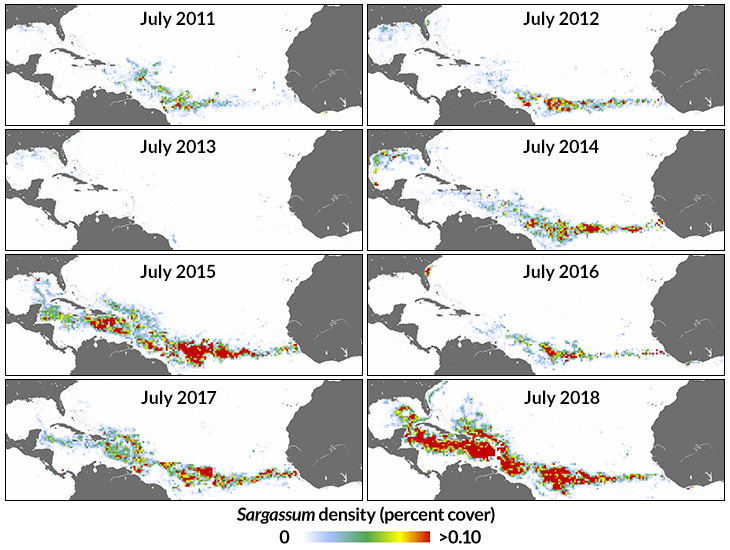
Satellite-derived density maps show broad swaths of high coverage across thousands of square miles of tropical ocean, implying cumulative surface areas on the order of possibly over 100,000 km² during peak months.
For 15 years, Atlantic sargassum has been more than doubling every five years, indicating exponential growth in both biomass and spatial footprint. This acceleration is indexed to warming oceans, increased nutrient inputs (from rivers like the Amazon and upwelling off Africa), and ecological feedbacks (e.g., nitrogen-fixing epibionts on the algae).
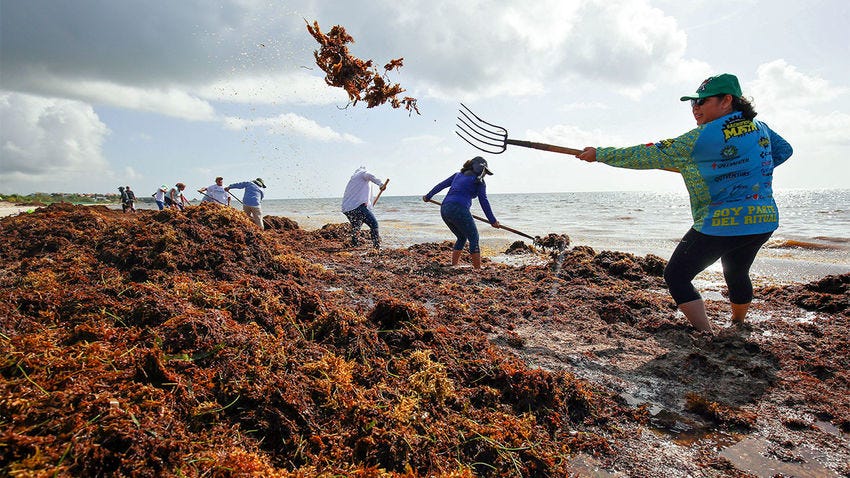
Take heart! Gaia’s emergency medics are on the scene and moving into triage overdrive.
A doubling time of five years means that by 2050, ocean algae will cover roughly 2.8 million km² of ocean surface, about 0.8% of the global ocean area. That is larger than the Mediterranean Sea. Total wet biomass today is on the order of 30 million tons. By 2050, it would be 840 million. But exponents are juggernauts.
By 2100, assuming no nutrient constraints and continued warmth, algal growth would be 2.86 billion km²—far larger than Earth’s total ocean area (~361 million km²) and even larger than Earth’s entire surface (~510 million km²). In other words, the unconstrained exponential model quickly becomes physically impossible. Long before then, by 2085, the entire ocean surface would actually be covered. Let’s hope it doesn’t come to that. That is 59 years from now. It’s time enough to convert an entire Navy of useless aircraft carriers and destroyers to seaweed-gathering vessels.
Glanris is looking for seed funding to launch a pilot seaweed-mash-to-biochar+power facility in Puerto Morelos. If you might be interested, or know someone, get in touch.
References
Bates, A. and Draper, K., 2020. Burn: Igniting a New Carbon Drawdown Economy to End the Climate Crisis. Chelsea Green Publishing.
Prasad, R., Gupta, S.K., Shabnam, N., Oliveira, C.Y.B., Nema, A.K., Ansari, F.A. and Bux, F., 2021. Role of microalgae in global CO2 sequestration: Physiological mechanism, recent development, challenges, and future prospective. Sustainability, 13(23), p.13061.
Tziperman, E., Halevy, I., Johnston, D.T., Knoll, A.H. and Schrag, D.P., 2011. Biologically induced initiation of Neoproterozoic snowball-Earth events. Proceedings of the National academy of Sciences, 108(37), pp.15091-15096.
Wang, M., Hu, C., Barnes, B.B., Mitchum, G., Lapointe, B. and Montoya, J.P., 2019. The great Atlantic sargassum belt. Science, 365(6448), pp.83-87.

Meanwhile, let’s end these wars. We support peace in Iran, Lebanon, the West Bank and Gaza and the efforts to end the war in Ukraine immediately. Global Village Institute’s Peace Thru Permaculture initiative has sponsored the Green Kibbutz network in Israel and the Marda Permaculture Farm in the West Bank for over 30 years. It will continue to do so with your assistance. We have a pipeline to aid in the West Bank that may only last a short time, so we appreciate immediate donations—right now.
We support Ukrainian families seeking refuge in ecovillages and permaculture farms along the Green Road, and we work to heal collective trauma worldwide through the Pocket Project. You can read about it on the Global Village Institute website (GVI.cool). I appreciate your support.

Could you help me get my blog posted every week? All Patreon donations and subscriptions to Blogger, Substack, and Medium are welcome. You are how we make this happen. Your contributions can be made to Global Village Institute, a tax-deductible 501(c)(3) charity. PowerUp! Donors on Patreon get an autographed book off each first press run. Please help if you can.
#RestorationGeneration.

We have a complete solution. We can restore whales to the ocean and bison to the plains. We can recover all the tremendous old-growth forests. We possess the knowledge and tools to rebuild savannah and wetland ecosystems. Coral reefs rebuilt with biorock build beaches faster than the seas are rising. It is not too late. All of these great works of nature are recoverable. We can have a human population sized to harmonize rather than destabilize. We can have an atmosphere that heats and cools just the right amount, is easy on our lungs and sweet to our nostrils with the scent of ten thousand flowers. All of that beckons. All of that is within reach.


yes
I am glad that your idea is getting attention. The NY Times had a report on this problem just today.
Navy amphibious ships (LHD, LHA, LSD, LPD) would be better than carriers or destroyers for that mission. The sargassum could be efficiently swept into the submerged well deck and compiled. Putting the seaweed then into shipping containers, you could fill the flight deck with the foul stuff before bringing it to shore. Better yet, do even further processing shipboard. The USS Peleliu is an LHA that is slated for target practice. I wonder if it could be restored and made into a prototype.